

Joey Calderazzo
 Piano
Piano

61 age

February 27, 1965 Birthday

New Rochelle, New York, U.S. Birthplace

www.joeycalderazzo.com Website

Social
About
Joey Calderazzo is a jazz pianist and composer who has been a central figure in modern mainstream jazz since the late 1980s. He first gained prominence as pianist in Michael Brecker's quintet, appearing on landmark albums including Tales from the Hudson and Two Blocks from the Edge. After Kenny Kirkland's death in 1998, Calderazzo joined the Branford Marsalis Quartet, where he has remained for over twenty-five years, contributing to albums such as Four MFs Playin' Tunes and The Secret Between the Shadow and the Soul. As a leader, he has released thirteen albums spanning Blue Note, Marsalis Music, and Sunnyside Records, ranging from the high-energy post-bop of his early work to the introspective solo piano explorations of Haiku and Amanecer. Based in North Carolina, he continues to tour internationally with the Marsalis Quartet and his own trio.
Trivia
Calderazzo is one of the rare musicians to have replaced the same pianist — Kenny Kirkland — in two different major bands: first in Michael Brecker's quintet in 1987, then in the Branford Marsalis Quartet after Kirkland's death in 1998. In 2017, he developed ulnar tunnel syndrome causing numbness in two fingers of his right hand, requiring surgery before he could return to performing. Despite being offered a scholarship to Berklee College of Music, he turned it down and also dropped out of Manhattan School of Music, choosing instead to learn on the bandstand.
Early Life
Joey Calderazzo was born in New Rochelle, New York, into a musical family — his brother Gene Calderazzo became a noted jazz drummer. He began classical piano studies around age eight, inspired by a piano-playing neighbor, and practiced Bach and Chopin for several hours daily. In his teens, his brother's interest in jazz drew Joey toward improvisation. He studied with pianist Richie Beirach, who exposed him to modern jazz harmony and became a formative influence. By age fourteen, he was performing in his brother's rock band on keyboards. He briefly attended Manhattan School of Music and Long Island University and was offered a scholarship to Berklee College of Music, but chose to leave academia and learn on the bandstand. In the mid-1980s, Michael Brecker heard him play at a clinic and invited him to join his quintet in 1987, launching his professional career.
Joey Calderazzo Solos
2024
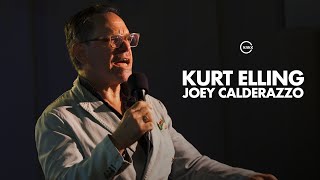
Piano solo - It's Only a Paper Moon - 2024
4/4 swing in C major at 123 BPM
Piano solo - Day Dream - 2024
4/4 ballad in E♭ major at 79 BPM
Piano solo - Straight, No Chaser - 2024
4/4 swing in F major at 223 BPM